CAFÉ TORTONI

Monserrat

Where Buenos Aires still speaks slowly


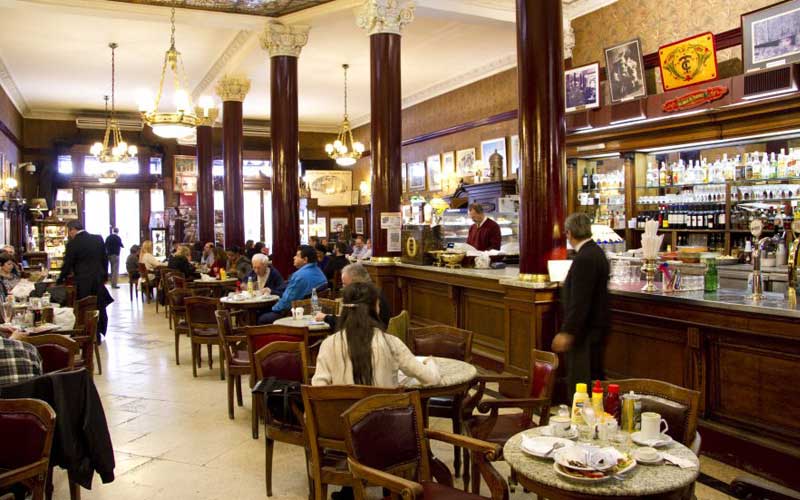
Among stained glass windows, coffees served on trays, and tables that seem to hold conversations from another era, Café Tortoni continues to function as a living portrait of the city.


There are places that survive the passage of time because they understand something essential: it is not necessary to reinvent oneself constantly to remain relevant. Café Tortoni works this way. In the heart of downtown Buenos Aires, behind a façade photographed by millions every year, there is still a daily scene that remains intact: seasoned waiters, curious tourists, writers taking notes, and porteños who still choose to sit without hurry.

Founded in 1858 and established since the late 19th century on Avenida de Mayo, Tortoni does not live only from its history. The key lies in its atmosphere. Entering means slowing down the rhythm of the city. The dim light, marble tables, dark wood, and stained glass create a feeling difficult to replicate in other historic cafés around the world: that of a space that is still alive.

For decades it was a refuge for artists, intellectuals, and musicians. Figures such as Jorge Luis Borges, Carlos Gardel, and Alfonsina Storni passed through its tables. But Tortoni’s current appeal does not depend solely on those names. Its relevance appears in the intersection between tradition and contemporary urban experience.

Today, travelers arrive seeking a classic postcard alongside young people who discover the place after a theater performance, a walk through the historic center, or an afternoon browsing downtown bookstores. The café functions almost like a porteño capsule: a synthesis of European architecture, Argentine social ritual, and well-understood nostalgia.

The experience changes depending on the time of day. In the morning, light enters from Avenida de Mayo and the hall has a quieter energy. In the afternoon, movement grows among trays, conversations, and tourists entering with cameras hanging from their necks. At night, especially during tango and jazz shows, its most cinematic side appears.

Beyond the classic hot chocolate with churros or coffees served with old precision, much of the charm lies in observing. Watching how the hall moves, how different generations dialogue in the same space, how Buenos Aires still preserves places where one can stay longer than planned.

In an increasingly accelerated city, Tortoni continues to propose something simple and increasingly scarce: to remain.