There are restaurants recommended for a dish. Others, for their decoration or for the fame of those who sat at their tables. And then there are those that are part of a neighborhood’s history.
El Obrero belongs to this last category. At Agustín R. Caffarena 64, a few blocks from the Riachuelo, this tavern in La Boca preserves much of the atmosphere that built its identity over more than seven decades. It opened in 1954, when the neighborhood had strong industrial and port activity, and its first customers were precisely the workers of the area.
Today it welcomes neighbors, porteños from other districts and travelers attracted by a combination hard to replicate: homemade cooking, generous portions and a dining room that seems to have accumulated stories on each of its walls.
From workers’ tavern to porteño bodegón
When Marcelino Castro and his brother Francisco opened El Obrero, the proposal was simple. There were soups, stews and meats, hearty dishes designed for those who needed to regain energy after a day’s work.
The name was no mystery either: El Obrero referred to those who frequented the place and to the working-class profile of La Boca in the mid-20th century. Over time, the neighborhood’s transformations also modified the menu. Factories and port activity lost prominence and the restaurant incorporated dishes that today are part of its identity, such as milanesa a la napolitana, revuelto gramajo, pastas, fried calamari and different cuts of meat.
Thus, the old tavern became a bodegón.
A dining room that tells stories
Entering El Obrero is almost like opening an album of Buenos Aires memories.
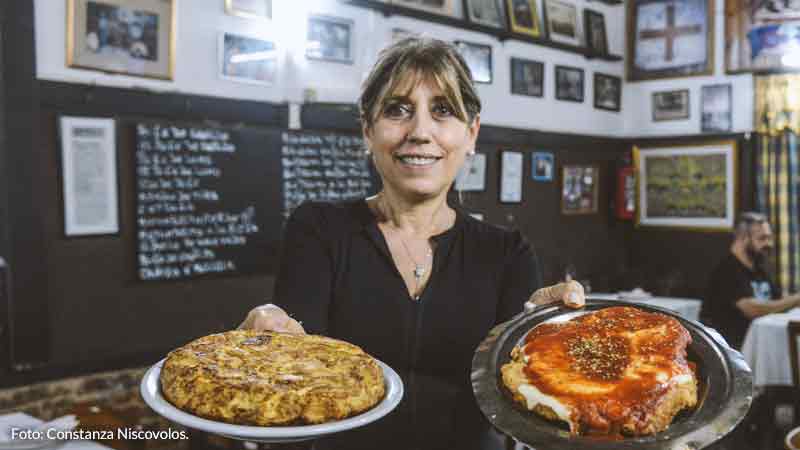
The walls are covered with photographs, football jerseys, pennants, portraits and objects that speak of different eras. There is no decoration designed to look old: the accumulation of objects is part of the place’s real history.
There are also anecdotes. Artists, writers, athletes and international figures have sat at its tables. The list includes names such as Bono, Willem Dafoe and Prince Albert of Monaco, among many others.
But perhaps the attraction lies precisely in the fact that these celebrities coexist, in the tavern’s imagination, with the neighborhood’s regulars.
That mix is profoundly porteño.
A kitchen without too many explanations
The menu follows a recognizable logic: generous dishes, familiar flavors and preparations that don’t need much introduction.
Among the classics are milanesa napolitana, fried calamari, Spanish omelette, revuelto gramajo, pastas and meats. The rice casserole with octopus, squid and mussels is another of the restaurant’s gastronomic highlights.
The proposal has something of amplified home cooking: familiar recipes, abundant portions and that feeling so typical of bodegones that the table should be full.
It is not sophisticated gastronomy. And that is precisely part of its charm.
La Boca beyond Caminito
El Obrero also proposes a different way of touring La Boca.
The neighborhood is often associated with Caminito’s colorful facades, football and the postcards linked to Quinquela Martín’s art. But there is another Boca, marked by immigration, the port, factories, taverns and a popular gastronomic tradition that built its own identity.
El Obrero belongs to that history.
Its location also allows combining the visit with other cultural spaces in the neighborhood, such as the Usina del Arte, the Benito Quinquela Martín Museum or Fundación Proa, creating a tour that mixes art, architecture, history and gastronomy.
A classic that reopened its doors
The recent history of El Obrero is also part of its identity.
The restaurant closed during the pandemic, after more than six decades of activity. In 2021 its reopening was announced and finally, in 2022, it resumed operations, maintaining the gastronomic proposal and much of the aesthetic that made it a classic.
That continuity explains much of its current appeal: more than recreating a tavern of the past, El Obrero remains a tavern that has lived through different eras.
And perhaps that is why it works so well as a Buenos Aires experience. Because here history is not behind a showcase or written only on a plaque. It is on the walls, in the recipes, in the waiters, in those who return and those who arrive for the first time.
In a city that constantly changes, sitting at a table in El Obrero is also a way of encountering a Buenos Aires that still preserves its rituals.
Useful information
📍 Where
Agustín R. Caffarena 64, La Boca, Buenos Aires.